Introduction
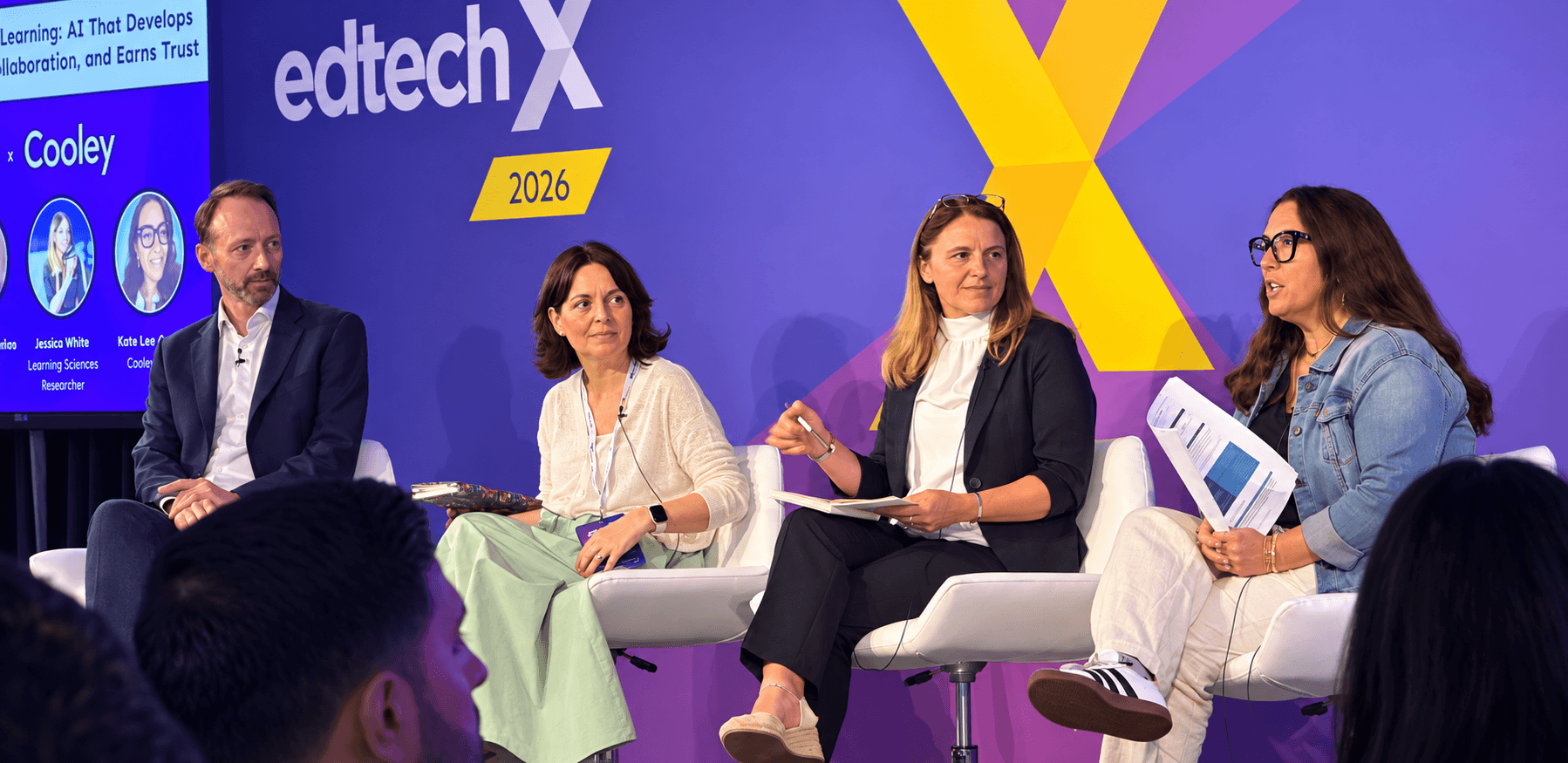
At EdTechX on the 16th June this panel with Adaptemy and Cooley LLP titled “Beyond Individualised Learning: AI That Develops Thinkers, Strengthens Collaboration, and Earns Trust.” was chaired by Kate Lee Carey of Cooley LLP, alongside Conor O’Sullivan founder of Adaptemy, and Lupe Sampedro, a data privacy legal specialist, also from Cooley LLP and Jessica Kennedy White, Learning Science Researcher and Learning Design Architect.
What made the conversation interesting, were the diverse opinions based on differing expertise and approaches. We were three people looking at the same question from three different angles exploring broadly: What does it actually take to build AI in education that develops learners rather than merely retains them?
What follows is not a recap. It’s an attempt to think through, in more detail than 25 minutes allowed, what the evidence and the conversation together suggest, and to offer a framework that has been emerging through pilots with Adaptemy, through the UCL EdTech Labs cohort, and through exactly the kind of cross-functional dialogue the panel modelled.
You can watch the recording of the panel at this link: 25 Min EdTechX Panel Discussion
The climate the conversation is happening within
The panel opened by naming something the whole room had felt in the weeks leading up to the event. This year, Gen Z graduates booed a former Google CEO off a commencement stage. At the University of Central Florida, a tech executive was heckled for calling AI “the next industrial revolution.” At Middle Tennessee State, a music industry leader told graduates to “deal with it” and was jeered in response. Recent Gallup data indicates that 42% of Gen Z believe AI will harm their job prospects; the same data shows a measurable shift among students toward human-centric fields that include philosophy, history and psychology and broader humanities, that prioritise communication, critical thinking, ethics, civic engagement, as well as ‘human flourishing’.
It would be tempting to read this as a straightforward anti-technology reaction. The evidence from our own pilots suggests it is something more nuanced and balanced. In a recent Adaptemy pilot with 13-year-olds, students were remarkably articulate about when they felt GenAI was helping them learn versus when they felt it was designed to keep them addicted. A couple of students made an explicit comparison describing how Adaptemy’s recent GenAI-supported compare-and-contrast approach where students were guided how to weigh up historical evidence or do hypothesis testing with physics “it didn’t do the thinking for them.” They noticed the difference.
This generation isn’t anti-AI. They are increasingly literate about the difference between AI that supports thinking and AI that enables addictive tendencies or diminishes their critical thinking
This distinction, between AI that develops learners and AI that just keeps you in an addiction loop, sits at the heart of what the panel was trying to work through. It also sits at the heart of a growing body of learning sciences research that has sometimes been slow to make its way into mainstream EdTech product conversations. Part of what I want to do here is bring some of that research into context with the questions founders, product teams, and legal/ ethics advisors are already asking
What EdTech has achieved and possibilities of where to go next
It is worth acknowledging what Edtech and personalisation have genuinely accomplished. The ratio of students to teachers is on average 30:1 in state schools and often more. Internationally we have seen 44: 1 and astonishingly in some overpopulated rural areas 100:2/3 and with AI Avatars. With teachers in short supply EdTech, as well as personalisation, can genuinely reach learners that can slip through the cracks and often go unnoticed for years before they are out of formal education and struggling to get into employment or create their own paths. On the other side of the scale, you have high achievers who may be smashing their grades in the performance of the exam, but two weeks later have forgotten most of what they learnt. Where strategic and superficial learning might work well for one off exam performance, what is often lacking in out of date education systems is deeper conceptual learning, where formative learning with meaningful and intervention based learning design, where learners have a chance to integrate, synthesise and master, retention falters. I have seen first-hand through research applied in the digital learning contexts that these transformations of not only learners but also whole systems that design for learning, not just testing, are possible. However, it is often hard to see them scale. Going into the “how” of those limitations here may take too long, however it is worth mentioning that maybe what is needed is a recalibration with the recent AI pervasiveness, that supports human flourishing in all its flawed complexity, rather than diminishing those very flaws that make us human.
 At the same time, there is a growing body of evidence suggesting that individualised delivery, on its own, is not the same as effective learning. Research on ‘productive struggle’ (Hiebert, J., & Grouws, D. A, 2007) and ‘productive failure’ (Kapur, 2008) has repeatedly shown that learners who have had some prior learning and then go on to “struggle” and sometimes “fail”; which includes making mistakes with interpretation or problems before receiving fuller explanations, are able to develop deeper conceptual understanding and stronger transfer than those whose difficulties are smoothed away.
AI in education needs evidence-based learning design that helps people think and learn more deeply. That often includes some kind of ‘struggle’ and often ‘failure’. As the famous adage famously said, ‘Ever tried, ever failed, no matter, try again, fail again, fail better’ (Beckett, 1983) Now there is a paradox, because many systems are simply not designed for this and have preference for superficial learning. However, is it possible to have impact in these systems through what we design? Learning design that scaffolds learners’ thinking without doing the thinking for them. A platform that can know the difference between a learner who’s struggling productively and one who’s just stuck. This structure may have a transformational ripple effect if it genuinely helps the learners and teachers to go a little deeper than just performing for a test only to forget a week or two later. Research on self-regulated learning shows that learners get better at directing their own learning when they understand why they are being asked to do something and how it relates to their broader progress.
Research on designing learning that is social shows that learners who work through problems collaboratively develop stronger capacities for monitoring and directing their own learning than those who work alone. This reminds us that reading, reasoning, and sense-making are fundamentally social acts requiring interpretation, peer feedback, and exploratory talk with teachers or trainers and peers in the classroom or workplace.
Taken together, this body of work points to something important: maybe individualised learning is not sufficient to produce both independent and collaborative skillsets and critically thinking learners. Students must learn to hold competing and different perspectives, shared through respectful dialogue to find a peaceful solution and way through. If we build AI that only serves the individual preferences of comparison and compare where one becomes the winner, we may be optimising for a narrower outcome than the one schools, families, and society actually value.
What a recent pilot suggested
One of the most instructive moments in a recent Adaptemy pilot with 13-year-olds came when learners appeared, on the platform metrics, to be sometimes disengaged. Interaction rates dropped. From an engagement dashboard perspective, these were the students the system might have flagged for intervention.
When we looked more carefully, through observation, student voice interviews, and think-aloud protocols, we found something quite different. Several of those learners were having their most productive struggle with each other, both at home and in the classroom. Not all of what they were learning with the platform had to be while interacting with the interface. The platform was a mediating and enabling factor in their learning, but that didn’t always show up in the dashboard metrics, we had to triangulate with other data. Furthermore I co-designed an education design based methodology that could set up the conditions for productive struggle (Schonberg et al, 2026) to be nurtured, minimising frustration. So, the platform can be central to their learning experience without students always having to be locked into their screens for all of that productive struggle to occur. At times for example in the classroom, they were pausing, re-reading, mentally revising, and comparing and synthesising their thinking with peers. They were working out equations or rationales together. In the History and Physics sessions, we identified distinct pathways of social regulation with the teacher and peers. This showed a ripple effect between and within students mediated by the platform, whilst learning Physics, where one learner’s breakthrough during exercises, shared with his peers, triggered visible collective motivation in the group, despite the challenging domain knowledge.
This was a small pilot, and it is important not to over-generalise from it. However, it illustrates a problem that runs deeper than any single dataset: the metrics some platforms rely on: quantity of content completion, dwell time, or time to finish or on task, can systematically mistake the visible symptoms of productive struggle for the visible symptoms of disengagement. Students themselves were clear about this. They said, in their own words, that they wanted to learn from their mistakes, that they were not afraid of getting things wrong, and that they wanted platforms that helped them notice and understand their mistakes rather than simply route around them.
“They wanted digital platforms that helped them notice and understand their mistakes, not route around them.”
A framework emerging from pilots and cross-functional dialogue
Through the pilots with Adaptemy, the UCL EdTech Labs cohort work, and conversations like the one at EdTechX, a set of five learning design principles have been taking shape. These are not as prescriptions but as questions worth putting to any learning product team. Each connects a research-informed observation to a concrete product question.
From frictionless UX to productive failure
The instinct in consumer product design is to remove friction. Applied uncritically to learning, this instinct can undermine the cognitive processes that produce durable understanding. The evidence from productive failure (Kapur, M. and Bielaczyc, K., 2012) research suggests that some friction within the sequencing of the learning design can be conducive to learning. Student input from the pilot is consistent with this: learners valued clear feedback on where and why they were wrong paired with step-by-step support to iterate on their own model answers, rather than being given model answers directly.
The product question: where in your key flows might friction be unintentionally removed in ways that short-circuit learning? Where is the platform doing the thinking that the learner should be doing?
Addressing the Whole-learner
Effective learning is holistic. Research consistently shows that platforms that respond only to content difficulty misses much of what is happening for the learner. A learner who is experiencing difficulty and about to disengage needs a different response from a student who is confident but working through a mistake that keeps occurring for them.
The product question: which of these learning signals are currently captured, and how do they inform your platform beyond content difficulty?

Orchestrating social and individual learning
EdTech solutions do not need to mean isolated. In the recent pilots, some of the most productive learning occurred when the platform mediated social dynamics that already existed in the learning and teaching environments. This sometimes looked like teacher led mediation, deliberately sequenced individual work, think-aloud explanation, peer discussion, and teacher-led synthesis. This is consistent with a substantial body of learning sciences research suggesting that individual and social learning are not alternatives but complements.
The product question: where do current designs explicitly invite teacher and peer interaction, and where might learners be inadvertently left in solo screen silos
Screen time as a pedagogical contract
Parents, teachers, and regulators are asking why children are spending increasing hours in front of screens sometimes with unclear evidence of improvement. Each 15–20-minute block of platform time can be thought of as needing to earn its place with a considered position in the wider learning sequence, for example what happens before and what happens after. Furthermore, there needs to be an intentional hand-off back to face-to-face or peer activity
The product question: what is the platform’s value of “screen-time contact” with schools, parents, and learners and can it be articulated clearly to them?
Governance, safety, and explainability as design features
The regulatory environment is tightening on two fronts simultaneously. As Lupe outlined during the panel, the EU AI Act classifies educational AI as high-risk under Annex III. Under the Digital Omnibus, the compliance deadline has been extended to December 2027, and member states are required to establish regulatory sandboxes by August 2027. The European Commission is actively offering funding, sandboxes, and stakeholder consultations to support companies in co-designing and testing their systems against European standards before enforcement begins.
Alongside this, a second regulatory wave is arriving that many EdTech founders are not yet tracking: the social media crackdown. This year’s landmark verdicts against Meta have established that addictive design can constitute actionable harm. Over a dozen countries, including Australia, France, Denmark, and the UK, are rolling out under-16 social media restrictions. EdTech is not social media. However, when a platform employs streaks, points, leaderboards, infinite scroll, or engagement-maximising algorithms, the line between educational technology and addictive design can become difficult to defend.
As part of the EdTech Lab AI cohort, we revisited the ethics for AIED research argument that the ethics of AI in education cannot be reduced to data and computation alone, it must also address pedagogy, assessment, agency. A system can be fully data-compliant while being pedagogically weak, or, increasingly, while using engagement mechanics that regulators are beginning to classify as harmful.
The product question: could a regulator, parent, or journalist look at the platform’s engagement mechanics and mistake them for a social media feed? If not, that difference is worth being able to articulate clearly.
From diagnosis to solutions: the window that is open
One of the most useful shifts in the panel is when the conversation moved from diagnosis to solutions. The EU compliance window to December 2027 is not a threat. It is an invitation. Companies willing to engage with sandboxes, participate in stakeholder consultations as well as co-design and proactively align their design with both data-privacy and learning-ethics standards will be ahead of the market when enforcement begins. The companies that can clearly articulate the difference between engagement that serves learning and engagement that serves retention will have a defensible position. The ones that cannot find themselves caught in a widening regulatory net.
A closing thought
The honest test of whether a platform is building responsible AI in education is not just a compliance checklist. It is closer to the test that 13-year-olds from the pilot were already applying without knowing the phrase: is this platform trying to help me think, or trying to keep me here?
The learners can tell. The teachers can tell. The regulators are learning to tell. The founders who take the question seriously and who invest in the research, evidence informed design, and cross-functional work needed to answer it well; those that consider these timely issues will be building the platforms that the next generation, the one that booed tech leaders off the graduation stage, might actually thank.
That is not a claim I want to make alone. It is one the panel made together, from three different disciplines.
References
Beckett, S. (1983). Worstward Ho. John Calder.
Kapur, M. (2008). Productive failure. Cognition and Instruction, 26(3), 379–424. https://doi.org/10.1080/07370000802212669
Kapur, M. and Bielaczyc, K. (2012). Designing for Productive Failure. Journal of the Learning Sciences, 21(1), 45-83. https://doi.org/10.1080/10508406.2011.591717
Schonberg, C., Hargis Becker, M., An, X. et al. (2026) Spaced Learning Supports Productive Struggle in an Online Learning Platform. Tech Know Learn 31, 365–381 https://doi.org/10.1007/s10758-025-09914-x
Hiebert, J., & Grouws, D. A. (2007). The effects of classroom mathematics teaching on students’ learning. In F. K. Lester Jr. (Ed.), Second handbook of research on mathematics teaching and learning (pp. 371–404). Information Age Publishing
The author is Jessica Kennedy White Learning Sciences Researcher currently completing her Ph.D. at the University of Sussex in Education and Human Computer Interaction, on how dialogue and evidence-based pedagogy in learning design shapes learners’ metacognition and deeper learning. She has been co-designing and evaluating research pilots with Adaptemy part-time, on evidence-informed learning design, this article draws on a pilot conducted with Adaptemy, and reflections through her research and exploring evidence based design with Adaptemy that she led through the UCL EdTech Labs cohort, as well as the recent EdTechX industry panel with Adaptemy and Cooley LLP.